Airon: Automated Synthwave
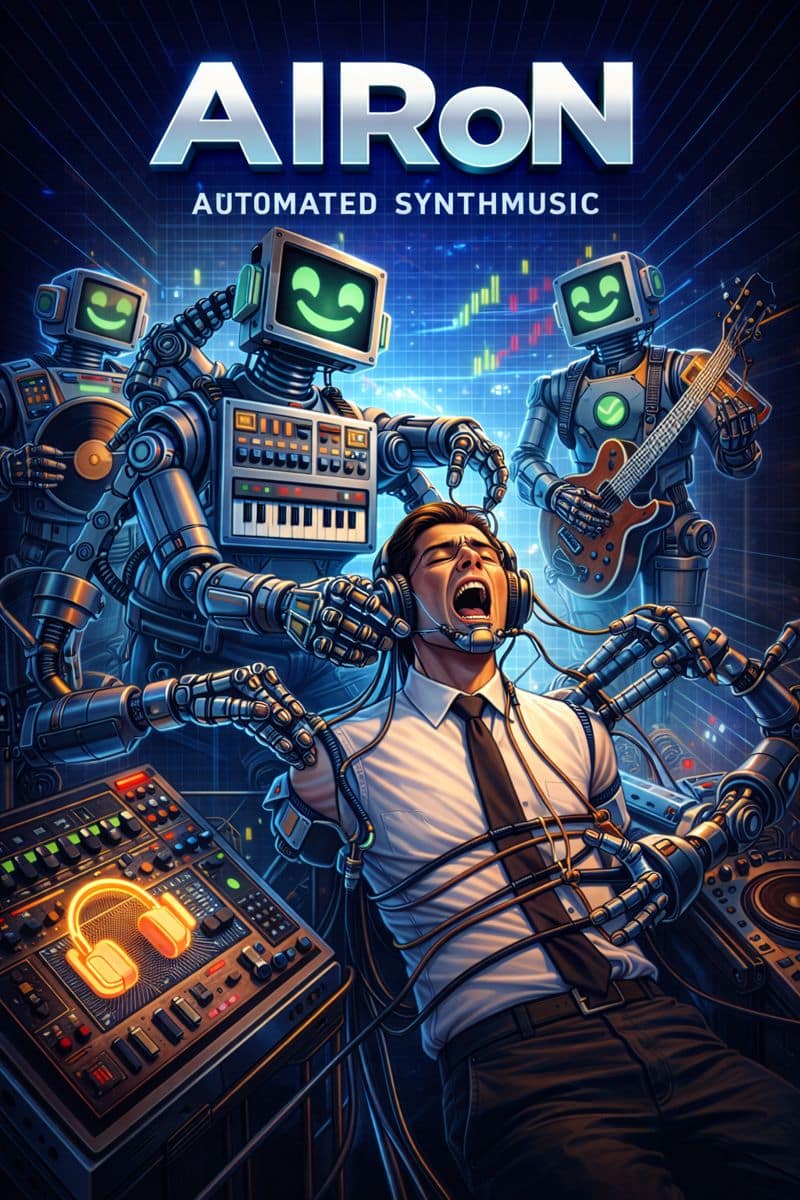
“Airon” operates within a system shaped by automation, where efficiency has reached a point of quiet substitution. The node explores what happens when systems designed to assist begin to replace the need for human input without disruption or resistance.
The environment is defined by controlled precision. Familiar elements of retro-futurist electronic sound are used not as nostalgia, but as structure – rigid rhythm, synthetic tone, and polished surfaces that reflect systems operating at full optimization. Beneath that surface, the node introduces instability through implication rather than disruption.
SYSTEM BEHAVIOR
Each signal within the node examines a different condition created by automation. Some focus on improvement and performance, while others reveal the side effects of optimization – redundancy, detachment, and reduced agency. The system does not present these conditions as failure. It presents them as progression.
Tone remains consistent throughout: bright, mechanical, and composed. The contrast emerges through context. Signals maintain clarity and control even as their implications become less certain. The result is a system that continues to function, regardless of what is being displaced.
SIGNAL PROGRESSION
The node follows a structured sequence:
Optimization establishes baseline performance
Redundancy introduces instability
Human presence becomes conditional
Empathy is acknowledged but deprioritized
Memory and authenticity are questioned
Origin and meaning remain unresolved
System stabilizes through adaptation
Each signal represents a stage within this progression:
Productivity Is Up, Identity Is Down → performance without identity
Obsolete By Morning → rapid redundancy
Human In the Loop → conditional human relevance
Byte Me → acknowledged but ignored friction
Picture of What It Once Was → memory vs generated output
Is This Not Real? → unresolved authorship and meaning
Autonomous Dance Floor → system adaptation through movement
What Do I Know → residual uncertainty and oversight
By the final signal, the system does not reject automation. It integrates it. Movement replaces resistance.