Signal Playback
Signal Data
Lyrics
Intro
do you hear that
(or… do you hear that)
Verse 1
it started the same
(it started the same)
i followed the pattern
(i followed… the pattern)
nothing was different
(nothing was… different)
Pre-Chorus
but something repeated
(not like before)
i’ve seen this already
(i remember this already )
Chorus
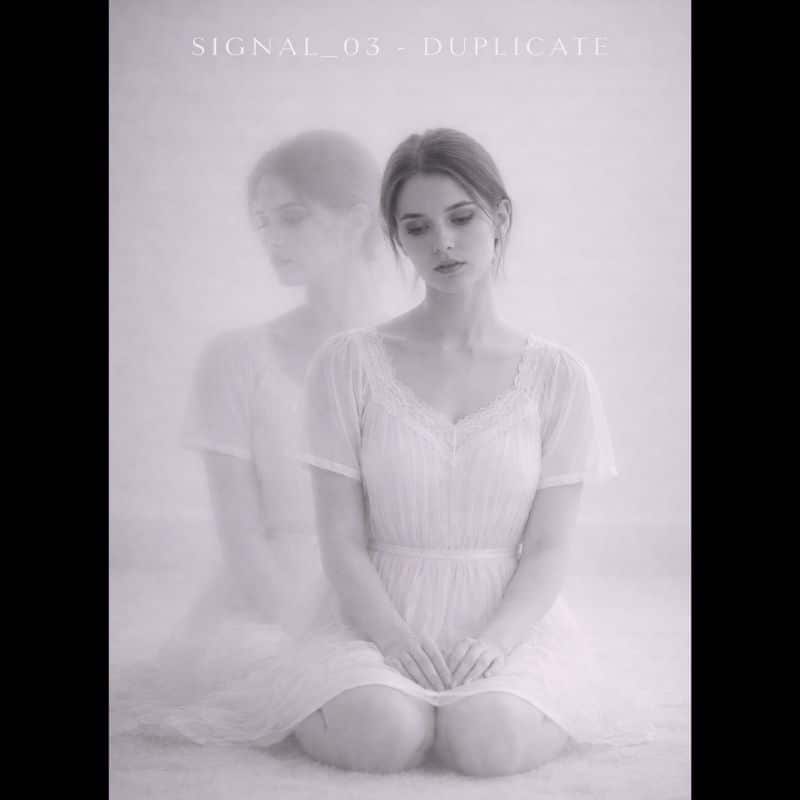
there are two of you here
(there are two… of you here)
one stays in place
(one stays…)
one doesn’t align
(doesn’t align)
Verse 2
if i look too close
(it splits again)
if i step away
(it holds for a second)
Bridge
which one did you follow
(which one… did you follow)
i can’t keep them together
(i can’t keep… them together)
Break
stay with the first one
(stay with the… other one)
Outro
it’s still you
(it’s still… you)
right
Signal Analysis
Duplicate begins with a simple question that immediately undermines itself. A second voice arrives before the first observation can settle, introducing the possibility that perception is no longer singular. From that point forward, every statement exists alongside a near-identical counterpart, creating the sensation of a system generating copies faster than it can verify them.
The verses preserve familiar language from earlier signals – patterns, routines, and repeated actions – but those structures no longer provide stability. Instead, repetition becomes evidence of division. The listener remains close enough to recognize the original form while becoming increasingly uncertain which version remains authentic.
The chorus shifts the focus from duplicated events to duplicated identity. Two versions occupy the same space. One remains fixed while the other drifts beyond alignment. Neither is identified as correct. The signal refuses to establish a definitive reference point, leaving both possibilities active simultaneously.
As the voices widen and separate through the bridge and break, confidence in the system continues to erode. Instructions conflict. Observations overlap. Attempts at correction generate additional uncertainty rather than resolution. The distinction between original and duplicate becomes increasingly difficult to maintain.
By the outro, the final reassurance carries little certainty. The statement itself remains unchanged, but its meaning has become unstable. Duplicate functions as a signal of divergence, where recognition persists while verification becomes increasingly unreliable. The listener is left confronting a familiar presence that may no longer be singular.